What happens when a mother's love truly knows no boundaries?
Golden Globe and EMMY nominated actress Sonia Braga and 'Ugly Betty' star Tony Plana lead an all-star ensemble cast in "Meddling Mom," a Hallmark original movie premiering February 16.
HOLLYWOOD, CA -- A matchmaking matriarch learns to mind her own business when three-time Golden Globe® and Emmy® nominee Sonia Braga (“Angel Eyes,” “Páginas Da Vida”) and Tony Plana (“Desperate Housewives,” “Ugly Betty”) lead a long list of dynamic performers in the World Premiere of “Meddling Mom,” a Hallmark Movie Channel Original on Saturday, February 16 (8p.m. ET/PT, 7C). Joining Braga and Plana are Mercedes Renard (“NCIS”), Ana Ayora (“Marley & Me,” “Phoenix Falling”), Saundra Santiago (“One Life to Live,” “The Sopranos”), Rose Abdoo (“2 Broke Girls,” “Gilmore Girls”), George Contreras (“The O.C.”), Rafael Amaya (“Doctor Mateo,” “Ugly Betty”) and Rob Mayes (“Jane By Design”).
Take Carmen Vega downtown and book her! Carmen (Braga) is guilty as charged of scheming with her two best friends, Marisol and Valeria (Abdoo and Santiago) to stick her nose in everything in her two adult daughter’s lives. From secretly leaving baby books out for recently wed daughter Yolanda (Ayora) and her husband Rico (Contreras) to manipulating youngest daughter Ally (Renard) into a doomed date with best friend Marisol’s son Pablo (Amaya), Carmen can’t stop interfering. Now, the notorious mother of good intentions with equally hideous results is about to get a crash course in butting out!
A widow, Carmen is happier to intrude on her daughter’s love lives than start one of her own, but Yolanda and Ally are tired of their mother’s meddling and start scheming to set Carmen up with Luis (Plana), a handsome ballroom dance teacher who’s crush on Carmen is no secret. Just as her family believes Carmen’s finally got a life of her own, Carmen proves her nosy habits die hard when she accidentally gets Ally’s new boyfriend Ben (Mayes) in trouble with his strict boss (John Nielsen, “Transformers: Revenge of the Fallen”). Suddenly, all the Vega women’s relationships are on the line. Will Carmen ever learn her lesson?
“Meddling Mom” is The Konigsberg Company in association with Silver Screen Pictures production. Frank Konigsberg, Kyle Clark, Lina Wong, Patricia Clifford and Iris Dugow are executive producers. Eileen Fields is the producer. Patricia Cardoso directed from a script by Nina Weinman.
Hallmark Movie Channel, the second linear channel from Crown Media Holdings, Inc., simulcast in SD (Standard Definition) and HD (High Definition), is a 24-hour cable network dedicated to bringing viewers family-friendly movies with a mix of classic theatrical films, presentations from the acclaimed Hallmark Hall of Fame library, original Hallmark Channel movies and special events. In today’s crowded television landscape, the network is a unique and captivating entertainment experience, providing programming families can watch together. It is now available in 48 million homes. Crown Media also operates Hallmark Channel, which provides a diverse slate of high-quality entertainment to a national audience of nearly 87 million subscribers.
Showing posts with label Latinos in Film. Show all posts
Thursday, December 13, 2012
Monday, December 3, 2012
Latino film director comments on Argo
Ben Affleck's Argo and the White-Washing of the Mexican-American
By Moctesuma Esparza, National Institute for Latino Policy
Editor's Note: This commentary first appeared on the National Institute for Latino Policy website.
![]() |
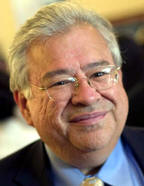
| Moctesuma Esparaza |
Argo is a 2012 feature film Hollywood thriller loosely based on a memoir written by Antonio "Tony" Mendez, a CIA operative, who led the rescue of six U.S. diplomats from Tehran, Iran during
the 1979 Iran hostage crisis. The film stars Affleck as Mendez, was
co-produced by Affleck, George Clooney, and Grant Heslov, and was
directed by Ben Affleck.
The
film is well done and satisfying as a thriller, and is now being touted
for awards consideration for the Golden Globes and Oscars. Although
there are many issues with the historical accuracy of the plot as well
as the portrayal of Canadians, and the Iranian people; and I understand
these issues as I have made a career of producing historical films and
biographies where I have striven to be as accurate as possible. I get
that dramatizations and inventions are part of the necessary compromises
needed to create a historical dramatic entertaining film. However, what
has been done in Argo falls into a different category of perpetuating ethnic and racial invisibility of Latinos in Hollywood.
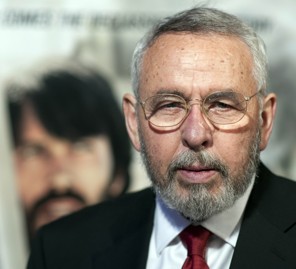
Antonio "Tony" Mendez is an American hero of Mexican ancestry whose exploits are dramatized in the movie Argo. He
was awarded the Intelligence Star for Valor for his role in the
rescue. He retired with the rank of SIS-2, the equal to a two star
General in the military. He was also awarded the CIA's Intelligence
Medal of Merit as well as the Intelligence Star and two Certificates of
Distinction. Antonio Mendez was one of fifty officers awarded the
Trailblazer Medallion from among all officer in the history of the CIA.
![]() |
| Antonio "Tony" Mendez |
I
have a tangential connection to the events portrayed in the movie as I
was working for Jerold Rafshoon, President Carters' Communications
Director in the White House during this time on the reelection media
campaign. I witnessed the impact of the Iranian hostage crisis on the
reelection efforts.
The
concern I am focusing on here is the director/producer's choice to
portray Tony as if he is a white non Latino, so he could play the role.
This is classic "brown face" at its worst. There is no reasonable
justification for this choice as the film could have been cast otherwise
without affecting its commercial viability.
Not
only did a Latino actor not play Tony, who clearly in real life looks
like a Chicano, but his ethnicity is stolen from the Latino community at
a time when Latinos have been demonized. Our real Latino national
heroes if acknowledged would dramatize our patriotism and contribution
to the United States. The film actually goes out of its way to obscure
Tony Mendez' ethnicity. His name (Mendez) is mentioned only once and the
character says he is from New York (Tony was born in Nevada from a
mining family with six generations in Nevada and raised in Colorado).
Nowhere in the movie does the viewer get that the hero is Mexican
American.
Ben
Affleck's portrayal of Antonio "Tony" Mendez was very contained and had
very little range, I don't know what Tony personality is like to judge
the portrayal but this did not impact the movie's success or failure. It
was an excellent role that would have elevated a Latino actor like
Benjamin Bratt or Michael Peña.
Instead, like with the story of Guy Gabaldon,
whose extraordinary achievements in the WWII Battle of Saipan,
capturing, by himself, 1800 enemy soldiers, more than any other
American soldier in the history of our country, was similarly
white-washed as Jeffrey Hunter played him in the 1960 film, "Hell to
Eternity." But that was more than half a century ago, Argo is now.
|
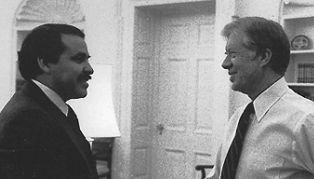
Jimmy Carter congratulates a
beardless Antonio Mendez on
the successful Operation Argo in 1980
|
In
the closing credits, the photos of the real people portrayed are
presented side-b- side with the actors' photos showing the very close
resemblance and care that was taken in the casting process to cast
actors who looked like the real people. Yet, for the key role of Tony
Mendez, the director/producer Ben Affleck chose a single long shot of
Tony with President Carter where his image was not distinct or
recognizable, breaking the pattern he had chosen for all the other real
people depicted.
In Argo
we have yet another instance where the public has been denied of an
opportunity for all Americans to learn of an American Latino's valor,
talent and patriotism. This occurs because there has been no
consequence to this behavior. It is time for a change.
Moctesuma Esparza is an award-winning producer, entertainment executive, entrepreneur and community activist. He is CEO of Maya Cinemas, a first run mainstream theater chain in the United States principally located in and serving Latino communities , and a partner of Robert Katz in the company Esparza/Katz Productions. He has produced over thirty films, and has won over 200 awards. He is the producer of such films as the Ballad of Gregorio Cortez (1981), Selena (1997), The Milagro Beanfield War (1988), Gettysburg (1993), Teddy Roosevelt and the Rough Riders (1997), Introducing Dorothy Dandridge (1999), Gods and Generals (2003) and Walkout (2006).
A participant in the 1960s-era movement for the civil rights and
equality of Mexican-Americans, Esparza remains committed to public
service, donating his time to educational, cultural, and professional
organizations, especially those that aim to educate Latinos in business and media.
He was born in Los Angeles, California and received a B.A. of Theatre
Arts-Motion Pictures, Television in 1971 and a M.F.A. of Theatre
Arts-Motion Pictures, TV in 1973 from the University California Los
Angeles. He can be reached at moctesumae@mayacinemas.com.
Monday, October 22, 2012
Latino actor to star in "La Llorona" Grimm episode
Actor David Barrera co stars on a Grimm groundbreaking TV Event
By Dr. Al Carlos Hernandez, Herald De Paris
(Edited By Susan Aceves)
David Barrera is an American actor best known for his latest role as Gunnery Sgt. Ray ‘Casey Kasem’ Griego in Generation Kill. He has appeared in several television series including Heroes, CSI: Miami, Boston Legal,Medium, Nip/Tuck, Without a Trace, The West Wing and 24 for which he was nominated for an ALMA award as best actor.The most recent film in which Barrera can be seen is Universal’s family comedy Evan Almighty. He worked on films like Infinity, No Way Back and The United States of Leland. Barrera guest starred in the episode ‘Alex Gives Up’ in a Disney Channel Original Series live-action sitcom, Wizards of Waverly Place – a series in which his wife, Maria, is a star player.
David Barrera was born and raised in San Juan, Texas and was the seventh of eight children. He attended Pharr-San Juan-Alamo High School, where he was involved in Theater. He received his BFA from Southern Methodist University on a theater scholarship. He went on to receive his MFA from The University of California, San Diego, where he garnered a San Diego Fellowship and was awarded The Princess Grace Acting Scholarship in his third year. While at UCSD, he was trained in and worked on several classical works of theater. He also did an internship at the prestigious La Jolla Playhouse and at Luis Valdez’ El Teatro Campesino. David is married to actress Maria Canals Barrera with whom he has two daughters.
On Friday October 26th a very special episode of NBC’s Grimm will be re-broadcast for the first time on Telemundo television. David will have a leading and ground breaking role. He said, “The episode will air on NBC, Telemundo and Mun2. The story deals with the legend of ‘La Llorona.’ I play a dad whose son is taken by her. We spend the episode searching for my son and La Llorona. It’s a really action packed episode and will have you on the edge of your seat. All my dialogue is completely in Spanish. One of the regulars on the series is fluent in Spanish and her character serves as my character’s translator.”
Here is the scenario:
Herald De Paris Deputy Managing Editor Dr. Al Carlos Hernandez had an inspiring conversation with David at the ALMA Awards:
Tell us about your family and growing up in Texas. What did your parents do and how was it growing up with seven siblings? How does your upbringing inform your work as an adult?
DB: I grew up in deep San Juan, Texas in an area of Southern Texas known as the Rio Grande Valley. I was born into a migrant farm working family of eight children. My family stopped traveling up north to work in the fields when I was around six or seven years old. This was a decision my mom made because it was hurting our education to be pulled out of school early in the summer and get back late for school in the fall. Although my family was of modest means, I remember a lot of laughter and good times. My dad later became a Jack-of-all-trades. He built houses and sold them for a while. He would buy and sell cars from time to time and had his own little lot for a bit. My mom was a lay-midwife (delivered babies) for most of her life. It was fantastic growing up in such a big family. We didn’t need anybody else. We had each other and friends were just icing on the cake. I think my upbringing informed my adult life in that I learned what hard work was from seeing my brothers and sisters working so hard from an early age. It also solidified the importance of family for me. Family comes first.
Who were your greatest supporters and who were the ‘nay sayers?’
DB: My greatest supporters were my parents and my family. They would support me in all my shows or the sports I participated in. They were my biggest fans. This gave me a lot of confidence in what I could do. I never saw failure as an option. I don’t think I ever had any ‘nay sayers’ - not any I could remember. I mean, you always run into people who are sometimes jealous of your accomplishment, that is natural, but I was always taught to ignore them and move forward.
What was it in your childhood that steered you towards the Arts? What was your first performance like?
DB: From my earliest years, growing up in a big family that loved to make each other laugh, I always enjoyed making other people laugh. It brought me great joy to tell jokes and be funny. That is where my want to perform was born. I remember when tryouts for the “creative dramatics” team came around in sixth grade, I jumped at the chance. I saw it as a chance to be funny in an environment where teachers did not tell you to stop talking. They encouraged it. I loved it! I then moved on into a high school that had a very strong theater department and was able to hone my passion into a more regular practice of my art. My first performance was exhilarating. It was at a “creative dramatics” competition in sixth grade against other elementary schools. Our team was very nervous, but we soon realized to just take the bull by the horns and perform. Very empowering. We placed sixth out of six schools, but it was a start. Ha! Ha!
When, and under what circumstances, did you know that you wanted to be an artist?
DB: I always knew I wanted to be and actor. I think a lot of kids have that dream, but it wasn’t until I was in college that I realized that it was actually possible. I realized that my belief that you are either really famous or a miserable failure was false. I realized you could be a working actor and make a decent living without the greater population knowing who you were. That seemed attainable to me. I went for it.
What was the reaction of your family when you decided to become involved in theater in high school? For Latino males, isn’t acting a nontraditional vocational choice? What kind of productions were you involved in?
DB: My family was very supportive. They loved it. We came from a family that had some singers in it. My mom sang at local shows when she was young and won competitions. For a while my parents had a singing ministry where they sang at various churches. Performing was kind of in our blood. It was never seen as a negative. Plus, the high school I went to was very successful across the state of Texas in drama competitions and because I grew up next to the Mexican border, most of us were Hispanic. Our community loved it. People would drive three or four hours to come see us compete at some of the One-Act Play competitions. It was always a plus.
What was the dream back then?
DB: The dream has always been to be a successful actor. To me that means working regularly and supporting yourself and your family from your art and enjoying the process of that. I have a very blue collar approach to it. I love to work. I work very hard and love getting chances to work. I love what I do.
Tell us how you earned your scholarship to Southern Methodist University in Dallas. What were some of the highs and lows during your college years at SMU?
DB: In my senior year of high school, three of us seniors were selected to go to a theater conference in Austin and perform audition monologues for all the colleges in Texas. You had to do a comedy monologue and dramatic monologue. After everyone had performed, we found out what colleges had called us back for an interview to see if we wanted to attend their university. I got a callback from a bunch of schools. I remember the University of Texas called me back and offered me a $500 dollar scholarship and I was ecstatic! I was a poor kid, so $500 was a lot of money to me. Well, then SMU called me back and I had no idea what a respected program they had. All I knew was that Eric Dickerson had played football there. It’s the best program in the state and one of the best in the country. They offered me a full ride and I just about passed out. Needless to say, I passed on UT and attended SMU.
The highs were being a part of such a prestigious professional actor training program. I was performing in plays with really talented class mates; growing and maturing in my craft. It was a student actors dream. The lows were being away from my family. I’ve always been very strong, but that was hard for me. It’s clear across the state, and Texas is huge! Ha! Ha! But, I grew from that experience as well. With the backing of my family, I became very independent and able to adapt to any environment.
What circumstances led to attaining an MFA from UC San Diego? Did you want to teach?
DB: In my senior year at SMU, a few of us were going to move to Chicago and start a theater company. I had no intention of going to grad school. One of my professors persuaded me to audition for at least a few of the more respected schools: Yale, NYU, UCSD. I did and was accepted at UCSD where I was offered a full ride plus a stipend to live on. I figured there was no way I could turn down such a wonderful program that was very respected in the professional world. I decided to go. It was a great decision. I got more great training and, through the showcases my class did in NY and LA, I landed my LA agent before I even moved here. I’m so glad I went there. I never had the intention of teaching. I always wanted to act professionally.
How important is it for Latinos in the arts to have advanced degrees?
DB: The degree doesn’t matter to anyone in the business. They couldn’t care less, but the training you receive is invaluable. One of the things my training affords me is a consistent level of performance from audition to audition. I learned that through technique at these schools. Consistency of quality auditions is the key to booking jobs. You can’t have too many off days.
What is the Princess Grace Acting Scholarship and how did you win it? What kind of doors did it open for you?
DB: Princess Grace Awards are given out by the Princess Grace Foundation (Princess Grace of Monaco) to honor artists who show excellence and promise in the disciplines of theater, dance, choreography, and film. I was picked in 1993 as the student award recipient for that year. Prompted by a professor, we submitted an audition tape plus a lot of paperwork and I won. It paid for my third year of grad school. It was a wonderful blessing.
http://www.pgfusa.com/award-winners/browse/by-year/1993/
Tell us about your work with El Teatro Compesino.
DB: In my third year of grad school, I got the opportunity to audition for an Octavio Solis play called ‘Prospect’ that was being produced by El Teatro Campesino. I was selected to play the lead role of ‘Scout’ and the school allowed me to do it as my externship that year. It was a great experience.
What was your first big break? What kinds of other jobs did you have before you ‘made it?'
DB: When I moved to LA I worked as a waiter at the Red Lobster in Beverly Hills. Thank God I could act, because I was a lousy waiter. I worked there four months until I got my first film. It was called ‘Infinity’ and it was directed by and starred Matthew Broderick. After that movie, a friend of mine got me a job a UCLA as a research assistant. The job was basically to hang out in the waiting rooms of clinics in South Central LA, approach people and ask all kinds of personal question and determine if they would be good candidates for the research study. I worked there for about a year until the study ended. Since then I’ve supported myself solely from my craft.
What are some of the TV shows and films you have worked on and what are some of the ‘types’ they book you for?
DB: I have 53 television titles and 14 film titles on IMDB.
http://www.imdb.com/name/nm0056876/
Some of those include NYPD: Blue, ER, The West Wing, The Mentalist, Heroes, Medium, CSI: NY and the HBO miniseries Generation Kill. I book a lot of roles for doctors, lawyers, cops and, lately, dads and detectives.
Which platform do you prefer the most: stage, screen, or TV?
DB: I prefer film. I think most actors do. There is generally a lot more time to shoot scenes in film. It takes time to develop a character, etc. Although lately, there are a lot more interesting scripts being done on TV than in film. Breaking Bad, Sons of Anarchy, shows like that. I think HBO started that trend with The Sopranos.Drama is, by far, my favorite. I still like being funny and making people laugh but I just find that in drama I feel very at home. It resonates with me a lot easier.
What was the first time you realized you were famous?
DB: The first time a stranger stopped me in the mall was pretty shocking. I usually get stopped for my arc on NYPD: Blue. People who stop me and loved that show feel like they know me as a member of their family. That was a very special show to a lot of people.
How did you meet your wife? How hard is it for two working actors to raise a family in Hollywood?
DB: I met Maria working on a staged reading at the Mark Taper Forum. It was called ‘The Seductions of Johnny Diego’ – I played Johnny Diego and she was one of my seductions. It was written by Guillermo Reyes and it was directed by Tony Plana. Within ten days, we were madly in love and still are!
It is difficult to juggle schedules with two working actors, especially with this current trend of leaving town for most jobs. We make it happen. We put our family first in every decision. That’s the only way to make it work. It comes with some sacrifice but at the end of the day we have each other and that’s all that counts.
Tell us about this very special episode of Grimm. I understand this is the first time Telemundo will re-broadcast.
DB: Yes. It will air on NBC, Telemundo and Mun2. The story deals with the legend of ‘La Llorona.’ I play a father whose son is taken by her. We spend the episode searching for my son and La Llorona. It’s a really action packed episode and will have you on the edge of your seat. All my dialogue is completely in Spanish. One of the regulars is fluent in Spanish and her character serves as my character’s translator.
How difficult was it doing the whole program speaking Spanish? What is your highest hope for this episode?
DB: It was not that difficult because the Spanish was written beautifully. So many times, if you get Spanish dialogue it’s written horribly and you end up having to translate on the fly. That can be difficult. But this was a joy to work on. My highest hope would be that the episode gets incredible numbers, NBC capitalizes on it to create more Latino characters and that there is more work for Latino actors. That would be amazing.
Do you think your career has been limited because of your ethnicity and/or moral posture?
DB: Early on in my career, I turned down a lot of stuff because it was stereotypical. Had I taken some of that stuff, my career would have moved further along at a much faster pace. However, I would not have been happy with my decisions. There are certainly not as many roles as I would like there to be for me to have the opportunity to work on – but I try not to ‘live’ in that. I try not to spend my energy getting upset about that. I focus on what is in front of me. I focus my energy on getting the work that IS available.
What are the kinds of parts you would like to play? What would be the perfect project?
DB: I would love to play a detective on a television series who investigates crimes. I would like it to shoot in town so I could be close to my family. That would be ideal for me.
What advice would you give to young actors who are just starting out?
DB: Get trained. Learn your craft. Learn what acting is and how to do it well at a consistent level and you will always work.
When it’s all said and done, 50 years from now how would you like to be remembered? What would you like your legacy to be?
DB: I would like to be remembered as a guy who worked really hard at what he loved and sometimes did it pretty well. A guy who always enjoyed what he did and treated people with respect and dignity as he did it. I would also like to be remembered as a good father and husband who was not defined by Hollywood, but tackled Hollywood on his own terms. That would be nice.
Sunday, September 16, 2012
Zoe Saldana 'not dark enough' for lead role
Controversy hits Hollywood as Zoe Saldana is dubbed 'not dark-skinned enough' to play Nina Simone
She's one of Hollywood's hottest rising stars, but apparently not everyone is a fan of Avatar actress Zoe Saldana.
Since
it emerged that the Dominican-Puerto Rican actress was to play jazz
legend Nina Simone in eagerly anticipated biopic, Nina, they has been
backlash about the colour of her skin.
Not dark enough? Hollywood producers have faced criticism for casting Zoe
An article by The New York Times states
that there has been a concerted attempt by certain members of the
online community to have Zoe removed from the role, as they don't
believe her to be dark-skinned enough for the part.
Tiffani Jones, who runs Coffee Rhetoric, raised the issue on her blog: '
Hollywood
and the media have a tendency to whitewash and lightwash a lot of
stories, particularly when black actresses are concerned.
'When is it going to be OK to not be the delicate looking ideal of what the media considers blackness to be?'
The
blog links to an online petition run by Change.org , which has nearly
3000 supporters, calling for director Cynthia Mott to dismiss Zoe from
the film and hire an actress whose skin tone is closer to Nina's.
There has also been disapproval from those who were closest to the late, iconic singer.
Nina's
daughter Simone Kelly has taken umbrage with the decision to cast Zoe,
and has taken to her Facebook page to voice her concerns:
'Appearance-wise this is not the best choice,' she wrote.
Although
Simone went on to say that she had no problem with the star's acting
ability, she admitted that she would like to see a darker-skinned
actress such as Viola Davis or Kimberly Elise take the part and
suggested that her mother would have wanted Whoopi Goldberg to play her.
Zoe,
who is hot property in Hollywood at the moment, has seen her profile
rise after starring in a string of blockbusters and dating the likes of
Bradley Cooper. She is rumoured to be starring in the forthcoming Avatar
sequel.
Monday, September 10, 2012
Film depicts Latino history in U.S.
![]() |
| The Untold Story of Latinos In America |
A Film Directed by Peter Getzels & Eduardo López
Produced by Wendy Thompson-Marquez & Eduardo López
Based on the landmark book, "Harvest of Empire," by award-winning journalist Juan González
To view trailer, click hereProduced by Wendy Thompson-Marquez & Eduardo López
Based on the landmark book, "Harvest of Empire," by award-winning journalist Juan González
At a time of heated and divisive debate over immigration, Onyx Films is proud to present Harvest of Empire, a feature-length documentary that examines the direct connection between the long history of U.S. intervention in Latin America and the immigration crisis we face today.
Based on the groundbreaking book by award-winning journalist Juan González, Harvest of Empire takes an unflinching look at the role that U.S. economic and military interests played in triggering an unprecedented wave of migration that is transforming our nation's cultural and economic landscape.
From the wars for territorial expansion that gave the U.S. control of Puerto Rico, Cuba and more than half of Mexico, to the covert operations that imposed oppressive military regimes in the Dominican Republic, Guatemala, Nicaragua and El Salvador, Harvest of Empire unveils a moving human story that is largely unknown to the great majority of citizens in the U.S. "They never teach us in school that the huge Latino presence here is a direct result of our own government's actions in Mexico, the Caribbean and Central America over many decades -- actions that forced millions from that region to leave their homeland and journey north," says Juan González at the beginning of the film.
Harvest of Empire provides a rare and powerful glimpse into the enormous sacrifices and rarely-noted triumphs of our nation's growing Latino community. The film features present day immigrant stories, rarely seen archival material, as well as interviews with such respected figures as Nobel Peace Prize Laureate Rigoberta Menchú, the Reverend Jesse Jackson, ACLU Executive Director Anthony Romero, Pulitzer Prize-winning writer Junot Díaz, Mexican historian Dr. Lorenzo Meyer, journalists Maria Hinojosa and Geraldo Rivera, Grammy award-winning singer Luis Enrique, and poet Martín Espada.
Screening Schedule
New York
Quad Cinema
Opens on September 28, 2012 - runs for ONE WEEK ONLY through October 4th
34 W 13th St # B New York, NY 10011
(212) 255-2243
Get tickets here
Los Angeles
Laemmle Theater
Opens on September 28, 2012 - runs for ONE WEEK ONLY through October 4th
Get tickets here
Easton, Maryland
Chesapeake Film Festival 2012
September 23, 2012
Get tickets here
Washington, DC
National Museum of American History
October 30, 2012
Smithsonian Institution
14th St. and Constitution Ave. NW
Thursday, March 29, 2012
Latino film producers to hold conference April 13-15
NALIP 2012: Diverse Voices, Universal Content to be presented April 13-15, 2012 at Universal City, California.
LOS ANGELES, CA -- The National Association of Latino Independent Producers (NALIP) today announced that its thirteenth annual NALIP Conference will be held April 13 - 15, 2012 in Universal City, California with a new special edition of the NALIP ActorSummit on April 12. Online registration is available now at http://www.conference2012.nalip.org/ .
NALIP 2012: Diverse Voices, Universal Content is presented by Time Warner and the National Latino Media Council. Co-chairs Frank B. Gonzalez of The Disney/ABC Television Group and Juan Carlos Zaldivar of Phonograph Films will host the annual, premier Latino nonprofit gathering of top level Latino executives, content makers and game changers in the Latino media field. This dynamic and star-studded weekend includes keynotes, plenaries, 'Conversations With,' workshops and networking events. The conference begins Friday, with keynote speaker, film director, screenwriter, producer, cinematographer, editor and musician, Robert Rodriguez. Rodriguez's films, which range from sleeper hit EL MARIACHI to FROM DUSK TILL DAWN and SIN CITY as well as the SPY KIDS franchise, exemplify how he embodies expressing a diverse voice while creating content that is universal. Saturday's keynote speaker will be Universal Studios' President and COO Ron Meyer. Meyer, the longest-running Studio Chief, is dedicated to creating a corporate culture of stability and consistency that drives a successful business.
In addition to engaging Hollywood's elite, NALIP also brings together the industry's current trendsetters. This will be exemplified in two very special sneak preview screenings during the conference. Friday night, the Sundance smash hit FILLY BROWN will be shown at Universal City's AMC Theatres. Following the screening, directors Youssef Delara and Michael T. Olmos, producer Amir Delara, and cast members Gina Rodriguez, Lou Diamond Phillips, Chrissie Fit, Emilo Rivera and Danny Mora will participate in a Q&A session. The second private screening and Q&A will be held Saturday afternoon for the Hallmark Hall of Fame movie of the week "Firelight." "Firelight" is directed by Darnell Martin and written by NALIP mentor and executive producer/ writer of the highly acclaimed LA MISA LUNA, Ligiah Villalobos.
Furthering the tradition of celebrating Latino visionaries, NALIP will host a red carpet gala honoring one of only eight living performers who has won entertainment's grand slam of the industry's most prestigious awards: The Oscar, The Emmy, The Tony and The Grammy -- the inspirational and magnanimous, Rita Moreno. Ms. Moreno will receive NALIP's highest honor, the Lifetime Achievement Award. Additional media luminaries being honored at the annual gala include former Nosotros President and current Velasco & Associates President, Jerry Velasco who will receive the Lifetime Achievement Award for Advocacy and the Estela "Rising Star" Award winners Patricia Martinez de Velasco, Erin McGinnis and Ari Palos, who will be awarded a $7,500 grant endowed by the McDonald's Corporation.
The Conference will also include NALIP's annual Latino Media Market, inviting top industry executives to help attendees bring their authentic, unique and diverse voices to the international market place. Executives from Time Warner, HBO, You Tube, Google, Sony, ABC/Disney, NBC, CBS, PBS, Fox, SAG, WGA, CNN, HGTV, Travel Channel, TruTV, Mun2 and many others are scheduled to attend this unique event. For a list of speakers, panels and keynotes please visit http://conference2012.nalip.org/conference/keynotes-speakers/ .
The NALIP national conference is organized as three days of workshops and plenaries on film, television and documentaries, plus groundbreaking case studies. These include "The Million Dollar Screenwriting Workshop", which turns writing into an effortless, step-by-step process, "Packaging your Documentary for Success", discusses how to best present your project pitch, proposal and trailer. "The Reality of Reality Television" presents an in depth look inside the world of reality television, why it works, the opportunities and how to break in. "Inside the Mind of the Investor: How Money Decisions are Made" explores how to prepare the best pitch and approach to maximize chances of success. Also scheduled are "Women in Media, Women Who Rock!" and "Make Money in TV Commercials."
Latinos watch more television, buy more movie tickets and consume more media than any other ethnicity, yet Latinos comprise less than 1% of executives in Hollywood; the percentage of minority industry writers in film and television has been frozen at 6% since 1999, and the percentage of directors is lower still. There are over 50 million Latinos in the U.S., which is more than Spaniards in Spain or Canadians in Canada. Latinos are estimated to expend over $1 billion on U.S. filmed entertainment, and $1 trillion in general market buying power. Twenty-six million U.S. moviegoers are Latino, most commonly between the ages of 12 and 34, and are 100% more likely than the national average to be considered "frequent moviegoers." Nielsen Media has determined that Latinos represent an overwhelming 28% of today's heavy moviegoers, that they buy more tickets per year than any other ethnic group, and constitute the fastest-growing segment of the overall movie-going population.
NALIP's closing plenary, Race and the Media, will engage in an insightful and important conversation about the systemic, economic and cultural factors affecting race and representation in the Media. Jennifer Lawson, Executive Vice President of Corporation for Public Broadcasting, Alex Nogales, Director of National Hispanic Media Coalition, Joe Torres, author of News for all the People, and Dr. Darnell Hunt, a sociologist at UCLA will discuss the effects of exclusion, and what can be done to improve representation of Latinos in front of and behind the cameras. NALIP's mission is to address the vital need for equitable Latino representation to the most underrepresented and largest ethnic minority in the country across all entertainment mediums.
Subscribe to:
Posts (Atom)